
The Shame That Is Unlearning Dominance Based Training
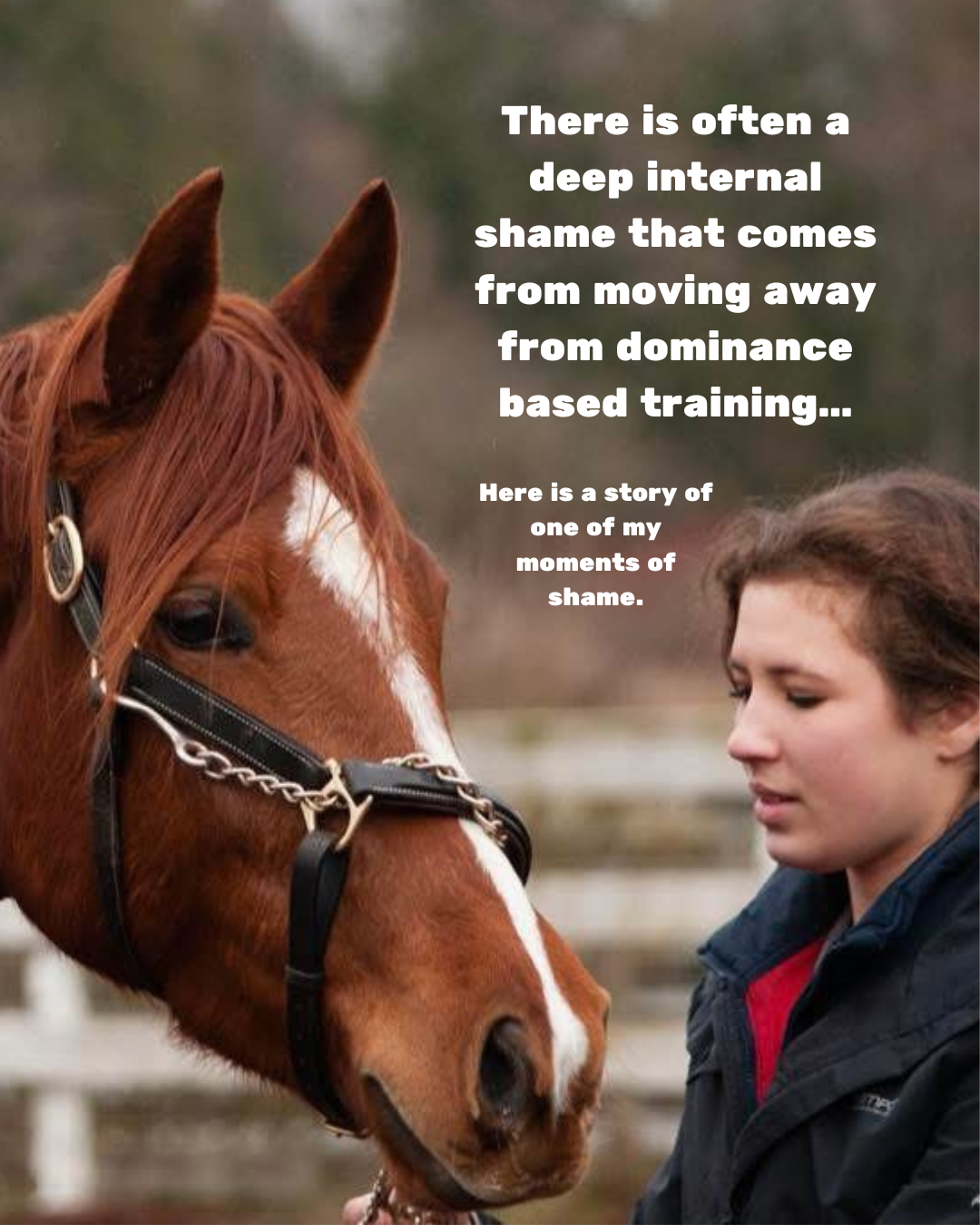
I got Milo when he was a young and very sensitive horse.
He had experienced significant neglect and miss handling by humans and, as a result, was suspicious and nervous.
I remember one time when I still had him on full board, he was just three years old.
He had pinned his ears at one of the barn workers while he was eating and they took it upon themselves to chase him out of his in/out stall with a pitchfork.
He panicked, ran out and caught his hip on the side of the door.
This created a several years long problem where he would be nervous of narrow doorways and would not want to go through, and when he eventually built up the courage to step through, he had to do it all in one go, very fast.
Obviously, this was dangerous, and it also made it more likely for him to land in situations where he would hurt himself by hitting his hip.
But, this behaviour was the result of human mishandling. It was not his fault. It was his physical reaction to fear.
The worker did not hit him, they didn’t hurt him physically themselves. But they created a scenario where he hurt and frightened himself because of how they utilized fear to try to modify behaviour.
Now, come in some mistakes that I made due to my own lack of patience, poor emotional regulation, and the dominance driven perspective on horse training that I was still working my way through at the time.
Most of the time, I could operate with enough patience that I would just stand slightly out of the way at the door and wait for him to come through on his own accord.
But, I remember one particular day, where for whatever reason I was in a rush. I was much more stressed. I was impatient. And I was tired of his behavior. I was tired of dealing with this same thing day after day for months.
And, I was still immersed in a world where people freely used very forceful tactics to address behavioural problems.
I had people making snide remarks about his issue with doors and suggesting that he needed an attitude adjustment.
While I ignored it most of the time, it did impact me internally.
I truly wanted to do better and I was actively trying to make changes, but I still reverted back to the original dominant driven training methods that I had grown up learning. Especially when I was under stress.
So, on this particular day, I decided the solution was putting a chain over his nose and continuing to pull on him and try to force him through the doorway.
When he inevitably blasted through the doorway, very uncontrolled and dangerously, I shanked him repeatedly with the nose chain.
Naturally, this did not help the situation at all. It made an anxiety problem even worse, and it’s completely disrupted any minor progress we had made with his fear of narrow passage ways.
It was imminently clear to me in the immediate following days.
I knew that I had lost my temper. I knew that I had lost my patience. And I knew that I had created an even larger issue for myself, all out of sheer stupidity and poor emotional regulation.
I was embarrassed, ashamed, and it’s a moment that I still think about today and feel immense discomfort over even though this was a decade ago now.
I wanted to share it here, not only to openly admit that those of us who now advocate for welfare often times have had moments where we have acted despicably but also to normalize the discussion of what triggers often lead people to being more comfortable with highly forceful training methods.
Because recognizing those triggers, the thought patterns and the conditioning that goes into it helps us to avoid repeatedly making these mistakes.
A huge setback for me as a Horse person was my reliance on external validation, and how much I internalized people’s snide criticisms, even when deep down I knew that their comments and suggestions were not right for my horse.
But, since I was young, and on paper had less experience than them, I would intermittently fold and cater my training to what I thought these people would expect of me, desperate for validation and fitting in.
In hindsight, of course, I should have had my horses well-being at the forefront, and I should’ve had the backbone to push back against advice that I knew was not right for him.
But, at the time I didn’t have that.
I was incredibly insecure. I was dealing with severe trauma outside of the barn where I had to constantly worry about family members and their safety.
I was dealing with financial stress. I was also dealing with the chronic anxiety that comes with OCD and compulsive behaviour that can result from that period
None of these things are to provide an excuse, but they are to discuss important setting events for why it was so easy for me to engage in dominating training tactics for so long and why it was so hard to get out of that mindset.
My behaviour was still harmful to my horse. It was still immensely unfair, but understanding what drives behaviour is as important in humans as it is for horses.
After all, behaviour is just the symptom of an underlying motivation.
It can be hard to alter patterns of behavior, especially when we’ve grown up in environments that deeply normalized certain behaviours.
And especially when leaving those environments often involves standing up to people who advocate for harsh practices and dealing with whatever response comes with that. Often times, the response is feeling ostracized.
I quite literally did not have the confidence, emotional energy, or capacity to do it until I eventually did.
In different circumstances, I think I would would’ve been better equipped to make different decisions. But, at the time I felt like I had very limited answers.
The coercive training environments that we immerse horses in are also modelled towards the humans. People don’t just use coercion on the horses they handle, they use it on the humans around them that question the ethics.
It just differs in the sense that the type of coercion used on people is often psychological and driven by community/mob mentality, rather than physical threat.
But, I wanted to share the story because this is one of the moments in my past that I think about a lot.
I think about it with guilt and shame to this day.
I think about how out of alignment it is with what I stand for currently.
And sometimes, I even feel like a fraud because of moments like this.
But, the feelings that make me feel that way are often in the mindset of those who judge me, not actually stemming from what I personally believe.
I am not the same person that I was then, I have grown exponentially.
So, I’m not going to hold myself to the standard of being that same person.
And if you have a similar story, you shouldn’t either.
Our worst moments are learning moments and while we can recognize how unacceptable our behaviour is, we must not be paralyzed by the wrongs we’ve committed to the point that we can never move past them.
How we choose to act in the present and how we choose to alter and better our behaviour as we learn more speaks for the most.
And sharing our mistakes and holding ourselves accountable, we create a safer environment for others to do the same.
I do firmly believe that the path forward to a more ethical Horse industry is people being honest about what growth looks like.
Because growth isn’t just suddenly choosing to be different and immediately being able to apply it without ever falling back into old patterns.
Ethical horse training is not just never making a mistake. It is not never buying into dominance driven perspectives.
Especially when we exist in an industry that deeply normalize this. It is insidious, it is hard to leave behind, and it requires a lot of deep unlearning that is not an easy process.
We need more individuals being honest about what the process of their shift in practises looked like.
So, I’m gonna start here by trying to share some of my stories of shame that still haunt me today.