A closer look at amino acids, calories, balanced nutrition, and the management questions behind a horse that is not building over the back.
A horse with a weak topline rarely looks weak in only one place. It is usually seen in the whole picture: the hollow behind the wither, the flatness through the loin, the hindquarters that do not quite carry the shape they should, the sense that the horse is fed and cared for, but still missing something.
That is often when owners begin looking for a topline supplement. And it makes sense. When the back, loin and croup are not filling in, nutrition is one of the first places worth examining.
But topline is not built by a label claim alone. It is built through enough calories, enough quality protein, the right amino acids, a balanced vitamin and mineral foundation, and the kind of movement that asks the horse to use their body well.
This is why the best topline supplement depends less on what the horse looks like from the outside and more on what is limiting them from the inside.
For horses that specifically need targeted amino acid support, Three Amigos is the clearest first choice in the Mad Barn lineup. It provides lysine, methionine and threonine, the three limiting amino acids most likely to hold back efficient protein use in the equine diet.
For other horses, the missing piece may be broader. Some need the forage-based diet balanced with Omneity. Some need the enhanced nutritional support of AminoTrace+, particularly when metabolic concerns, high-iron forage, hoof issues or harder work are part of the picture. And some horses do not primarily need a muscle supplement at all. They need more cool calories, where W-3 Oil may be the more appropriate tool.
The topline is not just decoration
The topline muscles run from the neck and withers across the back, loin, croup and hindquarters. They influence posture, balance, engagement, strength and the way a horse carries themselves under saddle and in daily movement.
When those muscles are underdeveloped or declining, it can affect far more than appearance. A poor topline can change how a horse feels in work, how easily they hold posture, and how much support they have through the back and hind end.
Still, this is where horse owners can get misled. A horse may look poor over the topline because they are genuinely lacking muscle. Another may look similar because they are underweight overall. Another may have pain, dental trouble, inconsistent work, an unbalanced diet, or age-related muscle loss quietly shaping what is visible on the outside.
The symptom is visible. The cause is not always obvious.
When amino acids are the bottleneck
Protein gets talked about as though it is one thing. In the horse’s body, it is more complicated than that.
Dietary protein is broken down into amino acids. Those amino acids are then used to build and maintain muscle tissue, connective tissue, enzymes, immune proteins, skin, coat, hooves and many other structures that keep the horse functioning normally.
The problem is that the horse cannot simply make every amino acid in sufficient amounts. Essential amino acids must come from the diet. And if one of the key amino acids is too low, it can limit how well the horse uses the rest of the protein available to them.
That is the logic behind Three Amigos. It does not try to solve every nutrition problem at once. It is targeted. It supplies lysine, methionine and threonine in a concentrated blend designed to support protein synthesis, muscle maintenance, topline development and recovery.
For many horses on forage-based diets, that distinction matters. The ration may appear to contain enough crude protein, but still fall short in the amino acids that decide whether that protein can be used efficiently.
This is why simply adding more protein is not always the most thoughtful answer. More is not automatically better. The horse needs the right building blocks in the right relationship to the rest of the diet.
When the foundation is the issue
There are also horses whose topline problems are not best explained by amino acids alone.
Forage should be the foundation of the feeding program, but forage is not consistent from farm to farm, field to field, or cutting to cutting. Hay and pasture can vary widely in energy, protein, minerals and vitamins. A horse can be eating plenty and still be missing important pieces.
This is where a complete vitamin and mineral supplement becomes part of the topline conversation, even if it is not marketed only as a muscle builder.
Omneity is the broader foundational option for many horses on forage-based diets. It provides vitamins, minerals, organic trace minerals, B-vitamins, digestive support ingredients and amino acids to help bring the overall ration into better balance.
AminoTrace+ is the more enhanced option for horses with higher nutritional demands or specific considerations, including metabolic concerns, high-iron forage, hoof quality issues or heavier workloads. It also supplies elevated levels of key nutrients, including amino acids, to support muscle metabolism, recovery and overall condition.
Neither replaces the need to understand the horse in front of you. They are most useful when the broader diet needs to be corrected before topline development has a fair chance to happen.
When the horse needs calories, not just muscle support
Sometimes the horse described as having a poor topline is also lacking body condition. The ribs may be too visible. The hip may look sharp. The whole body may have a flatness that is not only about muscle.
In those horses, the answer may begin with calories.
Calories do not build muscle by themselves. But without enough digestible energy, the body is not in a good position to maintain condition, support training, or spare nutrients for muscle development. A horse that is not meeting basic energy needs may continue to lose shape even with an amino acid supplement in the feed tub.
W-3 Oil fits this part of the picture. It is not the most direct topline supplement because it does not supply the limiting amino acids that drive muscle protein synthesis. Its role is different. It provides concentrated fat, omega-3 fatty acids and cool calories to support weight maintenance, body condition, coat quality and overall appearance.
For the thin horse, the senior horse losing coverage, or the horse whose diet is short on digestible energy, that distinction matters. Before asking the body to build, the ration may need to help the body stop falling behind.
The management questions that matter
Poor topline is rarely a single-cause problem.
Age can change how efficiently a horse maintains muscle. Dental issues can reduce forage intake and digestion. Pain can cause a horse to avoid using the back and hindquarters correctly. Poor saddle fit, lameness, chronic stress or inconsistent exercise can all change the way a horse moves and develops.
There is also the training piece. Muscle needs a stimulus. A supplement can provide nutritional support, but it cannot replace appropriate conditioning work. Horses build strength through progressive, consistent movement that asks them to engage the correct muscles without overfacing them.
That does not mean drilling the horse or turning topline into a performance obsession. It means recognizing that nutrition and movement are not separate conversations. The diet gives the body materials. Work, turnout, comfort and recovery influence whether the horse can use those materials well.
A horse cannot supplement their way out of chronic pain. They cannot mineral-balance their way around poor dental function. They cannot amino-acid their way through a workload that never teaches them to carry themselves.
The whole horse always comes back into the room.
How to choose the right Mad Barn option
The simplest way to approach topline supplementation is to ask what is most likely limiting the horse right now.
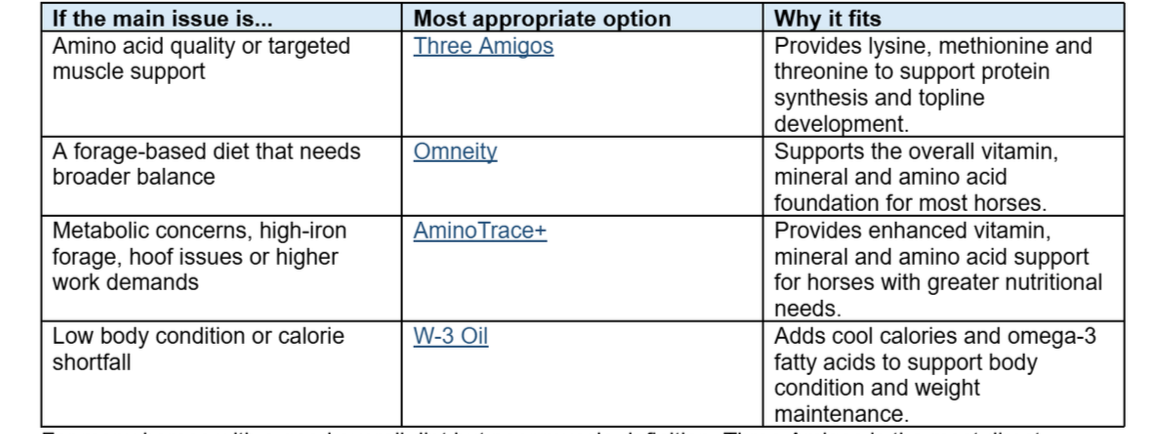
For many horses with a good overall diet but poor muscle definition, Three Amigos is the most direct targeted recommendation. For horses with unresolved nutrient gaps, Omneity or AminoTrace+ may need to come first. For horses that are not holding enough weight, W-3 Oil may be part of the plan before topline improvement becomes realistic.
What improvement should look like
Topline improvement is usually not instant. It is gradual, and it is most meaningful when the change is not only cosmetic.
A horse may begin to look rounder through the loin, stronger over the croup, or less hollow behind the wither. They may hold condition more easily. They may recover better from work or look less depleted during seasonal changes.
But the better question is not only, “Does the horse look different?” It is also, “Does the horse have the nutritional support, comfort and workload needed to maintain this?”
That is the part that turns a supplement choice into an actual management plan.
The bottom line
A weak topline is information. It can point to a shortage of key amino acids. It can point to inadequate calories, poor forage quality, low body condition, mineral imbalances, inconsistent exercise, discomfort, age-related muscle loss, or several of those things happening together.
For targeted amino acid support, Three Amigos remains the most specific Mad Barn recommendation because it supplies lysine, methionine and threonine for muscle protein synthesis and topline development.
For horses needing a stronger nutritional foundation, Omneity and AminoTrace+ help address broader vitamin, mineral and amino acid balance. For horses that need more condition before muscle can realistically come back, W-3 Oil offers calorie-dense fat support.
The right answer is not always the same product. It is the product that matches the reason the horse is struggling.
And when that reason is not clear, the most useful next step is not guessing. It is looking at the diet, the forage, the workload, the horse’s comfort and the whole management picture with more care than the topline alone can show.